Tuesday, November 28, 2006

And Last and Least ... One More Update ...

UPDATE (6:40): Per Bernie through Viva El Birdos:

-So Taguchi will apparently be back as well, but no discussion of contract or terms ... so much for Schumaker as the Taguchi replacement ...
-Jocketty and Schmidt's agent have had several "good" conversations and the Cards will make a competitive bid ... I'll withhold judgement until "competitive" is further qualified into length and $$$ (at first glance I'd much prefer a Lilly/Weaver combo) ...

Shooting Down Kennedy?

*** Disclaimer: Majority written prior to the Kennedy signing:

A popular rumor going around is that the Adam Kennedy sweepstakes are nearing an end, with the Cardinals currently in the lead for their former farmhand's services, ahead of the Blue Jays and Padres (link). If these reports are accurate, Kennedy's destination may be known within the next few days. Kennedy was said to be seeking a deal comparable to that signed by Placido Polanco in 2005 (4 years/$18.4 M), but the current Cardinals offer is reportedly around 3 years/$15 M.


It would be truly ironic if the first non-returning free agent signed by the Cards this offseason is at 2B, where in recent years the team has waited until the bitter end to get their man (Womack, Grudzielanek, Spivey/Miles/Belliard). If Kennedy is in fact the Cards' primary 2B target, the question then becomes: is he the right guy and, if so, how much is too much?


Below is a statistical comparison over the past 3-5 full seasons (dependent on the player) between Kennedy, the player whose contract he's seeking (Polanco), the player who he'd be supplanting in STL (Miles), and some of the more realistic FA/trade alternatives (Belliard, Loretta, Giles) ... sorry, it's kind of small/blurry (if anyone knows of a good way to input tables into posts, please let me know).

Observations:

1)
Kennedy is not Polanco, and thus should not receive a contract on par with Polanco's. Over the past 5 seasons, Polanco has been a better contact hitter with more pop and less strikeouts. In the field, Polanco has also displayed better range/zone coverage and has shown no indications of dimishing returns as he ages. Granted, the free agent market as a whole is over-inflated, but this is not the case at 2nd base, where the Mets' re-signing of Jose Valentin and the Indians' trade for Josh Barfield left more players looking for teams than teams looking for players ... consider that Kennedy, Belliard, Loretta, Durham, Walker, Graffanino, and even potentially Lugo/Aurilia are still looking for 2B jobs. At 2B, the market may in fact be de-flationary. Thus, the rumored 3 years and $15 M appears to be a significant overpay.

2) Kennedy is, however, a significant improvement over both Miles and Belliard (the current incumbents). He is statistically superior to Miles (and in a significant way) in essentially every category except strikeouts and, suprisingly, range, where Kennedy has exhibited a somewhat-alarming, steady decline over the past 5 years (this could become a concern with the similarly limited range of Eckstein). Compared to Belliard, Kennedy connects for less overall extra-base hits, but connects much more often, leading to a higher overall OBP and SLG. With Edmonds, Encarnacion, et al, there are already enough players that miss the ball altogether way too much in the lineup ... Kennedy would be an upgrade offensively over Belly. In the field, the two may be about a wash (although I admittedly don't know much about Kennedy's arm). Kennedy's defensive trends are alarming, but then so is Belliards' rapidly declining ZR. To me, this is vindication that he wasn't in fact THAT great of a defender, but rather took advantage of exaggerated positioning and just generally looked good for a fat guy fielding his position (that doesn't bode well for Belliard's future defensively).

3) Loretta is a solid overall player: a good contact hitter with a good eye and good pop and a decent defender. However, if you look more closely, he has been in significant decline both offensively and defensively over the past few seasons. At 30, Kennedy would be less of an injury risk and likely the better player at a lower cost.

4) Giles would be a great pick-up, but he would likely cost more money ($5-6 M/year) and a couple quality players to acquire (via trade). He hits for significantly more power than the other available options with a good eye and adequate defense ... he would be tailor-made for the #2 spot in front of Albert Pujols and is still young at 28. Giles would be my #1 choice to play 2B for the Cards in 2007 and beyond, but depending what it would require to obtain/retain him, Kennedy could prove the better option as an addition without subtraction.

5) Kennedy and Giles are the only available options that would legitimately provide speed to a SB-deprived team.

6) Although not shown in the above table, one thing to be conerned about with Kennedy is his relative ineffectiveness against LHP. Over the same span, Kennedy hit LHP at a poor .253 clip with a .657 OPS, almost .100 points lower than his composite average. With Duncan and Edmonds already penciled in for the 2007 lineup, adding Kennedy may make the Cards even more susceptible to lefties than they were in '06.

THE VERDICT: Aside from a reasonable Marcus Giles trade/extension, Kennedy is the best available 2B option for the Cards. At the outset, I wasn't super excited about Kennedy as a Cardinal (part II), but the more that I look at the numbers, the more I'd be relatively pleased about it. 3 years/$15M is too much, but at less than say $4 M/year for a couple of seasons, I'd be happy to have the never-ending 2B question answered early this year and the year-to-year merry-go-round finally halt. So no, Walt, don't shoot down this Kennedy right away ...

*** Post-Signing Announcement

So it's now official (link) ... Kennedy and Eckstein are re-united as a DP-combo for 3 years/$10 M. Kennedy certainly has his shortcomings and concerns to be watched closely (declining defensive range and HR totals), but he is a very solid player at an affordable price. In today's market, a starting position player at $3.3 M/year seems like a big bargain. With the signings of Kennedy, Wells, Bennett, and Marrero, Jocketty is at it again and can now focus on bigger prizes with some degree of payroll flexibility (2 of Schmidt, Lilly, Padilla, Meche, Weaver, or Suppan or maybe even an out of the blue trade for a marquee player like V. Wells/C. Crawford ... highly unlikely, but who knows?) It's been a good day overall in Cardinal Nation.

FA Update: Cards Sign Kennedy, Wells, Bennett, and Marrero

Today, the Cardinals made their first "splash" into the non-returning FA pool. Bernie reports the Cards have signed Adam Kennedy to a three-year deal and signed/re-signed Kip Wells, Gary Bennett, and Eli Marrero (minor league) to undislosed deals (link). No firm financial terms for these deals is available at the present time, but when they become available, I will be sure to update this post. Money-wise, both Bernie and the Toronto Star had discussed a 3 year/$15 M figure for Kennedy, but Ken Rosenthal is reporting the deal at 3 years/$10 M (link). I find Rosenthal's numbers hard to believe, but if accurate, it could be a steal ... we'll just have to wait and see. I should have a post on Adam Kennedy/2B up later this evening that I was in the process of writing as the news broke.

UPDATE (3:45):
Both Jerry Crasnick and Ken Rosenthal are now reporting the Kennedy contract at 3 years/$10 M, so I think we can be fairly confident in that figure ... we'll have to wait and see on the year to year breakdown, clauses, etc. Also, the Bennett contract has been reported by the Post Dispatch as a one-year deal and Mike Claiborne has reported the Kip Wells contract at one year as well (no financial terms on those deals available yet, though).

UPDATE (4:10):
(Link) Financial terms for 3/4 deals are now available (not Marrero's).

Kennedy
: 3 years/$10 M (as reported) ... $2.5 M in 2007, $3.5 M in 2008, $4.5 M in 2009 (no word of any options)
-Will discuss at more length in a subsequent post, but a solid deal that stops the merry-go-round at 2nd base for the forseable future without breaking the bank ... weren't many (if any) superior options available for the price ... initial grade: B+

Wells: 1 year/$4 M
-Solid upside signing to solidify the back end of the rotation; could be #4/5 starter depending on subsequent moves. Under Duncan's tutelage (if healthy), could have #3/borderline #2 stuff ... probably a better signing than Woody Williams at 2 years/$12.5 M. Would have liked to see a club option if he flourishes like Suppan, Weaver, etc. and the pitching market continues to hyper-inflate. Can't complain about $4 M, though ... leaves money to go after bigger fish for 2 open rotation slots (Schmidt, Lilly, Weaver, Padilla, Suppan, Meche?) ... initial grade: B

Bennett: 1 year/$850 K, mutual $900 K option for 2008 w/$50 K buyout
-Wasn't super impressed with Bennett's defense/arm, but was much better than Diaz. Showed he can be a decent hitter at times (ahem, Cubs series) and was reported to be a good clubhouse presence. Made better by the Marrero signing ... initial grade: C+

UPDATE (6:40)
And last and least ... per Bernie through Viva El Birdos:
-So Taguchi will apparently be back as well, but no discussion of contract or terms ... so much for Schumaker as the Taguchi replacement ...
-Jocketty and Schmidts' agent have had several "good" conversations and the Cards will make a competitive bid ... I'll withhold judgement until "competitive" is further qualified into length and $$$ (at first glance I'd much prefer a Lilly/Weaver combo) ...

Lefty-less?

In 2006, the Cardinals managed to win the World Series without a left-handed starter for the majority of the regular season and the entire postseason. Can they do it again, and even so, would it be advisable?

Returning once again to my analysis of the past 10 World Series champs, only 2 have not had at least one regular lefthander in their starting 5 ('06 Cardinals, '04 Red Sox). If you expand that to the participants from the last 10 World Series, only 4 out of 20 have gone sans lefty in their rotations ('06 Cardinals, '04 Red Sox, '04 Cardinals, '97 Indians). So, in theory, could the 2007 Cards yet again make and win the World Series without a lefty starter? Yes, sure they could. However, statistically speaking, the odds are strongly against it (4:1).

Furthermore, to win the World Series, you have to make the World Series. The Cards may be the reigning champs, but with any additional pitching (which they will certainly get), the Mets will enter 2007 as the prohibitive favorites to win the NL. The big reason why: their heavy-hitting, left-leaning lineup (think Reyes, Beltran, Delgado, Green, Valentin). In 2006, the Cards did manage to squeak by the Mets in 7 games. However, it was more a result of an injury-depleted Mets rotation than an indication of the Cards' righty starters effectively neutralizing the Mets' dangerous lefties. Consider the following starters' statistics against the Mets in 2006 (including the postseason):

-Chris Carpenter: 0-1, 5.73 ERA, .394 Opp. BA

-Jeff Suppan: 1-1, 1.99 ERA, .162 Opp. BA

-Jeff Weaver: 1-1, 4.32 ERA, .300 Opp. BA

-Anthony Reyes: 0-0, 4.50 ERA, .250 Opp. BA

-Jason Marquis: 1-1, 5.27 ERA, .250 Opp. BA


With the exception of Suppan, who was beyond brilliant in the NLCS, the Cardinals starters were less than stellar vs. the lefty lumber of the Mets. Now consider the Mets' lefties' splits against the Cards in 2006 (including the postseason):

-Jose Reyes (S): .310, 3 HR, 10 RBI, .879 OPS

-Carlos Beltran (S): .229, 5 HR, 9 RBI, .925 OPS

-Carlos Delgado: .304, 6 HR, 17 RBI, 1.223 OPS

-Shawn Green: .289, 0 HR, 4 RBI, .716 OPS

-Jose Valentin (S): .233, 1 HR, 6 RBI, .743 OPS


On the whole, and particularly with respect to the Reyes/Beltran/Delgado trio ... ouch. Even though the 2007 Cards could, in theory, win the World Series without a lefty starter, is it advisable? Absolutely not.

Rather, it would be prudent for Jocketty to acquire (likely via FA) a potential #3 (or higher) left-handed starter, who could face the Mets twice in a post-season series. Note the OPS differentials for the above Met hitters facing left vs. right-handed pitching:

-Jose Reyes (S): +.067

-Carlos Beltran (S): -.220

-Carlos Delgado: -.224

-Shawn Green: +.034

-Jose Valentin (S): -.235


Of the originally available free agent, LH starters, only 5 have/had legitimate #3 or better stuff (listed alphabetically):

1) Tom Glavine
2) Ted Lilly
3) Mark Mulder
4) Randy Wolf
5) Barry Zito


However, the realistic targets for the Cards are likely limited to only Lilly and Mulder. Glavine is reportedly interested in only the Braves and Mets, Wolf has already agreed to become a Dodger, and Zito is well out of the Cards' price range. That being said, all early indications are that Mulder will not be "in the Cards" (pardon the pun) for St. Louis in 2007 ... and I'm not sure that's such a bad thing.

Currently, the Mulder trade stands as one of the worst deals Walt Jocketty has made as Cardinal GM (although even in hindsight, I probably would have done the same thing). In many ways, I feel that retaining Mulder for a potentially overpriced, incentive-laden deal may be nothing more than an attempt to hope that somehow the Mulder mistake remedies itself. If I could have some sort of real assurance that Mark Mulder would revert to his old form, I would make such a deal in a heartbeat. However, ever since the 2nd half of '03, Mulder has been a shell of the pitcher he once was. His fastball has dropped from the low 90's to mid 80's and his offspeed pitches have lost the movement and dive that onced induced ground ball after ground ball. Just as I believe there was no reason to expect Mulder not to rebound in '04, I see no reason to expect Mulder to revert to his old form. And that leaves only Lilly.

In such a depleted, over-inflated market, the Cardinals could do much worse (Lilly's stats). Lilly will only be 31 come Opening Day '07 and has been relatively durable in recent years, averaging 30 starts and 170 innings over the past four seasons. Much like Zito, Lilly is a flyball pitcher with a mediocre fastball (high 80's) and two excellent offspeed pitches: a 12-6 curve and a plus changeup. Over the course of his career, Lilly has been a solid strikeout pitcher, averaging almost 8 K/9 IP, something the Cardinals' rotations have seriously lacked in recent years (someone who misses bats). The biggest knock on Lilly is his control. At times, he has a tendency to nibble and throws too many pitches per plate appearance, walks too many batters, and thus doesn't go as deep into games as he might otherwise. However, in many ways (save not being a groundball pitcher), he is the prototypical Dave Duncan project: a competitive veteran with good stuff who needs to focus more on pitch efficiency and trusting his stuff, by attacking batters and pounding the strike zone more consistently. Lilly pre-'07 reminds me a lot of Daryl Kile, Chris Carpenter, and Jeff Weaver before coming to the Cardinals to work with Dave Duncan. Under Duncan and throwing more strikes, Lilly could very well be a solid #2/3 starter behind Cy Carp in St. Louis. Oh, and concerning the Mets' sluggers in the postseason, Lilly would do just fine ... he held lefties to a splendid .539 OPS in 2006.

Lilly would fit many needs for the Cards in 2007 and beyond, but he won't come cheap. In a market where Adam Eaton gets $8 M/year after two injury-ridden, predominantly ineffective seasons, Lilly could demand $9-10 million a season for 3-4 years. Granted, this would be an overpay by at least $2-3 million per year, but sometimes, you have to overpay to fill a need (see Looper and Encarnacion last offseason). At least in the case of Lilly, the Cards would be filling a need with a consistent, high ceiling player, perhaps the best combo of past production and future potential of all the starters on the market, left or right handed (although a similar argument could be made for Padilla). In many ways, Lilly is not far off par with Zito, the consensus top non-Matsuzaka pitcher on the market, widely rumored to soon receive at least $15 M/year for 5, 6 or more seasons (look for yourself below). At $5 M plus less for half the contract length, I'll take Lilly over Zito any day.

(Averages from 2003-2006)
Lilly: 7.46 K/9, 3.70 BB/9, 0.15 HR/IP, .253 BAA, .428 Opp. SLG
Zito: 6.37 K/9, 3.58 BB/9, 0.11 HR/IP, .240 BAA, .382 Opp. SLG

Unfortunately, I'm not too optimistic about a Lilly-Cardinals marriage becoming a reality any time soon. There hasn't been much talk in informed circles regarding the Cards' interest in Lilly, while there has been considerable talk about both interest from East Coast teams and Lilly's interest in West Coast teams. Unless Jocketty ups the ante salary-wise for Lilly (because we almost certainly will have to overpay), the chances of a second-straight World Series title with an all right-handed rotation will be slim to none. There just aren't many other true front to mid rotation lefties out there, and I can't think of any logical trades that the Cardinals could make that wouldn't either significantly hurt other areas of the club or jeopardize the future ... think Willis, etc. However, if Lilly does in fact sign elsewhere, don't lose all hope. We Cards fans can always hope and pray that Chris Narveson will set the world on fire in 2007 ...

Monday, November 27, 2006

Oh 'Stro Good

-Fact: The Astros overpaid for Carlos Lee at 6 years, $100 million.
-Fact: The Astros may have overpaid for Woody Williams at 2 years, $12.5 million.
-Fact: The Astros have (arguably) had the best offseason of any MLB team thus far this offseason …

… Why? …

1) Filling Needs
Coming into this offseason, the Astros had just as many questions to answer as the Cardinals, if not more. Like St. Louis, Houston was scheduled to return only 2/5 starting pitchers, one a perennial Cy Young candidate (Oswalt) and the other a promising 2nd-year player (Hirsh), who dominated AAA (13-2, 2.10 ERA) but struggled to find consistency in the majors (3-4, 6.04 ERA). Again, like the Cards, 3 of the Astros' 5 rotation spots were in question (due to Clemens'/Pettite's FA and Backe's Tommy John surgery) with only one #4/5-type lefty as an in-organization option (W. Rodriguez as opposed to C. Narveson). As such, like the Cards' w/Suppan (presuming Clemens' departure/retirement), the Astros likely needed to fill 3 rotation holes via FA/trade, one by hopefully resigning Pettite (like Weaver) and the other 2 by signing/trading for tier 2 (Wolf, Jennings, etc.) or tier 3 (Williams, Wells, etc.) FA's. Currently, from a starting pitching standpoint, the 'Stros are right on track.

Again, the Astros may have overpaid for Woody, but on the flip side, he could turn out to be a minor steal. Personally, I thought that Woody would receive a 1-2 year contract in the range of $4-5 M/year, even though in today’s inflated FA market, his past history would warrant a 3+ year contract at $7-9 M/year. My projection was influenced mainly by 1) age, 2) lack of overpowering stuff, and 3) a public desire to pitch in either Houston, SD, or STL (effectively shrinking his potential market). Even now (signed), there are concerns with Woody, especially as it pertains to Houston. First, the statistics show that Woody is a fly-ball pitcher. This, coupled with his underwhelming velocity, makes the short porch in the joke that is Minute Maid Park a legitimate concern for Williams, who can be pull-susceptible. Second, Woody will be 41 next August and, although historically durable (with a few exceptions), age eventually catches up with everyone. Thus, compared to my projections, the Astros overpaid.

However, all that being said, if Woody can continue pitching to his historical norms, he will instead be relatively underpaid. Prior to his signing, I was lobbying hard for the Cardinals to sign Williams for a second tour of duty. Despite his increasing age, Woody is the type of pitcher who ages well, as his game is more dependent on location than velocity. He is the textbook example of a “crafty veteran,” a good hitting/fielding pitcher, a positive clubhouse presence, and perhaps most importantly, a known quantity (as opposed to a “potential” player). I still believe that he would have fared better in St. Louis than in Houston (#3 vs. #4), because of the Crawford Boxes, but as a Houston native coming home full of pride and hoping to impress his friends/family, I think that, barring injury, a reasonable expectation for the Astros could be a low to mid-high 4 ERA with double-digit wins and close to 200 innings pitched (essentially a Suppan-lite). In today’s market, that Woody is certainly worth at least 2 years/$12.5 M and could become even more affordable in subsequent/options years depending on how future free agency years develop (who would have thought that AJ Burnett’s contract would look relatively affordable one year removed).

The Astros are now in a good position from a starting pitching perspective (at least compared to the Cardinals). If they can resign Pettite (which all indications say they can), the Astros are a Kip Wells-type away from a solid rotation and a Wolf/Jennings (via trade … Rockies are reportedly interested in Burke, Taveras, and/or Lidge) type away from a borderline formidable rotation (Oswalt, Pettite, Wolf/Jennings/etc., Williams, Hirsh) for 2007. There are still more ifs than answers, but the Astros are certainly on the right track for 2007 pitching-wise.

However, unlike the Cardinals, the Astros also needed to massively overhaul a lineup that in 2006 finished dead-last in the NL with a .255 batting average and 12/16 teams in runs scored. For the most part, it was expected that the offensive overhaul would occur via outfield turnover. With the potential exception of Morgan Ensberg at third base, it is widely expected that the Houston infield will remain the same in 2007, with Adam Everett and Brad Ausmus entrenched at shortstop and catcher respectively for defensive purposes, and 3,000 hit-seeking Craig Biggio and (in my opinion) the most underrated player in baseball, Lance Berkman, manning the right side of the infield. However, chalk me up as a believer that Ensberg will once again be patrolling the hot corner in Houston come Opening Day 2007. Although Ensberg spent the majority of 2006 either on the bench or in Phil Garner’s doghouse, he merely had a down year. Sometimes, he may be too reticent to take the bat off his shoulder, but given the dearth of third base FA options (Aubrey Huff may be the best still available) and the lack of in-organization alternatives, I find it difficult to see Purpura trading an above-average defensive 3rd basemen with moderate to moderate-high pop and a good eye who historically posts an OPS in the high .800’s to .900’s for around $6 M a year … that is unless he gets a no-brainer offer.

Thus (and rightfully so), the overhaul had to begin (and end) with the outfield. In 2006, the Astros did not have a single, full-year regular at any of the three outfield positions. Furthermore, the tandem of Jason Lane, Luke Scott, Chris Burke, Willy Taveras, Aubrey Huff, et al combined to hit only .258 with 48 HR's. With the Duncan-like emergence of Luke Scott in the second half, at least one of the corner outfield spots (likely right) was filled for 2007. However, who would play both left (presumably) and center field was a subject of great debate until only recently. At the beginning of the offseason, the Astros had very publicly expressed their interest in obtaining at least one (if not two) of the few “marquee” outfields available on the market, which included Alfonso Soriano, Carlos Lee, and Gary Matthews, Jr. (sorry I’m having trouble not laughing while typing his name in the same sentence as the word “marquee”).

Say what you will about Carlos Lee and his contract, but the Astros got their man and the right man to boot. Absolutely, the Astros overpaid for Carlos Lee, a below-average defensive outfielder that has never posted an above-.900 OPS in his career, but sometimes you have to overpay for a player who fills a huge hole for your team. The Astros needed a big-time hitter to hit cleanup and allow good, but-not-great hitters like Ensberg, Scott, and Burke to hit in their appropriate positions in the order, and boy, can Carlos Lee hit. The deceiving thing about Carlos Lee is his OPS. In fact, as disparaged as Morgan Ensberg was this year, his OPS numbers were relatively comparable to Lee’s. Thus, is Ensberg as good of a hitter as Lee? Certainly not. The difference is that Lee is a hitter’s hitter, whereas Ensberg is more of a new-age hitter (one who values walks as highly as hits), whom the OPS statistic benefits most. Lee’s OPS is “low,” because his OBP is relatively low compared to his batting average. Over the past 3 seasons, Lee walked only 54, 57, and 58 times, while batting .305, .265, and .300 respectively. The result: modest OBP numbers of .365, .324, and .355. However, his strikeout numbers were also comparably low at 86, 87, and 65 respectively. What does this mean? It means that Lee puts the ball in play more often than most and does so with a considerable amount of power. If you believe in the value of a productive out and avoiding strikeouts as do I, then this is an intrinsic positive not measured in Carlos Lee’s OPS.

The bottom line is that Carlos Lee makes the Astros lineup much more competitive, both directly and indirectly, by putting the other hitters in a better position to succeed. The Astros may very well still obtain another bona fide hitter like Willy Mo Pena by trading the enigma known as Brad Lidge, Willy Taveras, etc. (probably not Burke, despite the rumors, due to his high value as a 2008 Biggio replacement), but for the moment, assuming that Lee is the only starting position player change for the Astros in 2007, just notice the difference in the look of their lineup.

2006:
1) Biggio
2) Burke/Taveras
3) Berkman
4) Scott
5) Huff
6) Ensberg
7) Everett
8) Ausmus
9) Pitcher

2007:
1) Biggio
2) Scott
3) Berkman
4) Lee
5) Ensberg
6) Burke
7) Everett
8) Ausmus
9) Pitcher

You may disagree, but I find the 2007 lineup, albeit not intimidating, much more competitive than the 2006 version. Save for Lance Berkman and Luke Scott (at times), competitive is not a word often used to describe the 2006 lineup. Just for the detractors of Carlos Lee, chalk me up as one of the first to predict Lee’s first above-.900 OPS in “The Juice Box” in 2007. I wouldn’t be shocked to see a .280, 40 HR, 100 RBI line next season.

2) The Versatility of Lance Berkman
In criticizing Carlos Lee’s defensive prowess (or lack thereof), many “experts” have quipped that Carlos Lee is eating himself into a DH role. As such, an NL team signing Lee to a long-term contract was viewed as a considerable risk. Although I have previously stated that the “experts are idiots,” in this case I happen to concur that he was better suited for an AL team, with one notable exception … the Astros. Aside from being a phenomenal hitter, Lance Berkman has shared one more thing in common with Albert Pujols over the course of his career … he has been somewhat of a defensive nomad. Berkman is now also a first baseman like Pujols and is quickly developing into an above-average fielder at his position. However, Berkman was arguably a much better defensive outfielder and not quite the Gold Glove at first like Pujols. Thus, if Carlos Lee does in fact eat himself into a DH role, the Astros can merely swap the positions of Berkman and Lee without much ill effect. Lee will turn 37 in the final year of his contract. While I certainly believe his defensive capabilities will have significantly diminished, I see no reason to believe that his offensive prowess will follow suit. Sure, 16.7 million/year is a lot to spend on the NL version of a DH, but if he makes the rest of your team better, there are definitely much worse investments.

3) Constructing a Core
The Cardinals have sustained success during the Tony La Russa era using a rather simple formula … building around a core. For the past few years, that core has been Jim Edmonds, Scott Rolen, Albert Pujols, and more recently, Chris Carpenter. With the growing insanity of the free agent market and the increased emphasis on retaining young, cheap, home-grown talent, roster turnover will continue to increase from year to year. One of the few ways to maintain year-to-year continuity and consistent success is by assembling a core group of talented players, much like the Walt Jocketty blueprint. In many ways, the Astros have now begun to assemble a similar core in Oswalt, Berkman, and Lee. Transitively, Lee is now the Astros’ Rolen. While the Astros’ current threesome may not measure up in stature to the Cardinals MV3 + Carpenter, it’s certainly a start. Without Lee, the Astros had only Berkman and Oswalt. In every sport, the true superstar needs a sidekick. Jordan had Pippen. Pujols has Edmonds and Rolen. In may be unfair to Carlos Lee, but he has been signed to be Berkman’s Pippen. In this market, they could have done far worse.

The bottom line … there’s still a lot left to play out in the current offseason for the Cards, the Astros, and everyone else. I’ve been pleased with the Cardinals moves (and lack of moves) thus far. If I was an Astros fan, though, I’d be even more pleased with the aggressive actions of Tim Purpura. Spending money is risky, but I think the Astros have spent it wisely thus far. I once told my good friend from Houston that the Cardinals rivals were the Cubs, not the Astros. A few more years and offseasons like this, and I may have to eat my words.

Sunday, November 26, 2006

Thoughts On The Outfield ...
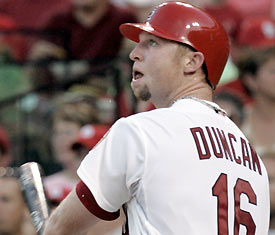
Right now, the Cardinals have even more questions to confront this offseason than they did last year. First and foremost is the issue of starting pitching - OBVIOUSLY. Anyone remember last year when we needed two corner outfielders? Well surprise! ... We still have outfield problems. Here are my thoughts on the 2007 Cardinals outfield, broken down by position.

LEFT FIELD:
Almost every offseason report you read raises the same question: Is the Chris Duncan we saw in 2006 for real or merely a fluke? I think those of us who are sane realize that Duncan's not going to hit 50 homers and drive in 150 next year. We DO have reason to be somewhat skeptical, as Duncan's 2006 slugging percentage was over 100 points higher than his previous career high. Still, that .363 OBP doesn't appear to be a fluke. He put up a .393 OBP in AA in 2004 and a .358 OBP in AAA in 2005, and thus is very valuable in front of Albert Pujols in the #2 spot. Additionally, we all know that Duncan is a great fastball hitter. The best place to see plenty of fastballs is in front of Pujols.

It is possible that Duncan reverts to his better minor league years, putting up a .260/.360/.500 line, and he could be even worse. His splits against lefties are downright terrible. At this point, he definitely looks like a platoon player. Also, we all know that Duncan's fielding is right up there with Manny's. Still, the guy has only played in the outfield for a year, and since he spent most of his career at first, he's not used to seeing the ball off that side. I personally have no doubt that his fielding will improve. And although he still could be a bust offensively next year, Bill James predicts Duncan's 2007 stats at something like this:

.273 BA, 33 HR, 90 RBI, .351 OBP, .511 SLG.

If you ask me, the possibility of 33 home runs and an .862 OPS from a player making the Major League minimum is too good a risk to turn down, even if he is a poor-fielding platoon player.

Verdict - Chris Duncan


CENTER FIELD
:
No real questions here - Jimmy's our guy. I think it's safe to say that his days of 40 home runs, .300 average, 1.00+ OPS seasons are over. Still, the guy's been real banged up the past year and with offseason surgery and a few months to rest, I think Jimmy will make a return to form, of sorts, during the 2007 season. I'm thinking perhaps a .275 average, 25 home runs, and an OPS in the high .800's. If he stays healthy, I could see him hitting 30-35 home runs, posting a low .900 OPS, and maybe even winning another Gold Glove. I don't want to be overly optimistic - Jimmy Baseball's issue is always staying healthy - but we do have some reason to hope. Anyone remember the last time Edmonds came back from offseason shoulder surgery?

Verdict - Jim Edmonds

RIGHT FIELD
:
As of now, we've got Juan Encarnacion penciled in next year for a cool $5 million. That's still a lot of money, but is anyone still as furious about his contract as they were last year? After the insane stupidity of the Pierre, Matthews Jr., and Soriano deals (the Cubs making bad signings makes my world go round), a league average right fielder for $5 million looks pretty good right now. If he was out in this ridiculous free agent market, some foolish team would probably pay upwards of $9 million for Juan's services.

In fact, I think this free agent market has really done us a HUGE favor. What was once seemed like a deadweight contract is now, dare I say it, a somewhat valuable trading piece. I know what you're thinking - JUAN AND VALUABLE IN THE SAME SENTENCE? - Hear me out on this one. In right field, Juan's numbers are basically league average and mediocre. But think about center field, where his numbers are well above average. If schmucks like Juan Pierre and one year wonders like Gary Matthews Jr. can make upwards of $10 million a year, doesn't Juan seem like a pretty attractive deal to a team in need of a non-lead-off center fielder? If I'm Walt Jocketty, I'm seriously looking for deals to dump Encarnaci-suck. Some names to consider, should Juan be traded:

Jose Guillen:
Guillen is coming off an injury plagued season, but the guy is a real solid right fielder when healthy. At worst he'll give you league average offensive production, and at best he can hit you 30 home runs and put up an OPS in the upper .800s. He's also a great defensive player with an absolute cannon of an arm. Having a good defensive right fielder is really important, as it allows Edmonds to cover more ground towards left and makes a less than stellar left fielder (Duncan perhaps?) much more tolerable. Still, Guillen has a fair number of drawbacks: anger management issues, failing to stay healthy, and lack of plate discipline. The health issue is, in my opinion, the most pertinent. Edmonds is already penciled in and is already a serious injury risk. Can the Cardinals really afford to go a long stretch with two starting outfielders on the DL? Still, Guillen has a lot of promise, and in this insane market, he could end up being a very nice bargain.

Trot Nixon:
Nixon is the same serious injury risk as Guillen, and also will probably be similarly undervalued since he's coming back from a season plagued with injuries. Still, Nixon is very productive when healthy; you can count on Trot to hit around 25 home runs and put up an .850 OPS. The guy certainly has above average plate discipline. He's also a lefty, and how good would he look hitting behind Rolen in the 6 spot? In theory, if we got Nixon and a left-handed basemen like Giles or Kennedy, you could go R-L-R-L down the whole lineup, which is a huge plus. My biggest concern with Nixon is his miserable .648 OPS versus lefties. We've already got Duncan, who can't hit lefties worth a lick; do we really want Spezio and another bench player manning the corneres EVERY time we face left-handed starters?

Verdict - Encarnacion ... for now...

UTILITY OUTFIELDER #1
:
The very minimum requirement here is that the outfielder be able to play both corner positions. Ideally, the team would get a player who can play all three outfield positions, has a combination of pop and speed, and mashes lefties. I see three free agent possibilities and one in-house one:

Preston Wilson
Wilson had a good run with the Cardinals this season after being acquired in August. Supposedly Preston was a big voice in the clubhouse during the playoff run, having never been to the playoffs before this year. Wilson plays an adequate center and is a good defender at the corners. He has both some speed and some pop, but he doesn't exactly mash lefties. Over the last three years, Wilson has posted an .862 OPS against lefties, which is good but not exactly great. Still, he's a known quantity and would be OK as a backup and platoon partner with Duncan.

Craig Wilson
This other Wilson hits lefties slightly better than Preston, putting up a .875 OPS against lefties in the past three years. He's also a versatile player who can play both outfield and infield corners, as well as catcher. Despite that versatility, he's not a particularly good defender, especially in the outfield corners, where he's not much better than Duncan. Also, he doesn't really have any speed, stealing only 14 bases in his six-year career. Wilson is only two years removed from a 29 homer season, which will certainly drive up his price. Personally, I'll pass on Craig - we've already got our super-utility guy in Spezio
.

Jose Cruz Jr.
Cruz is a plus defender anywhere in the outfield, winning a Gold Glove back in 2003 with the Giants. He's also a switch hitter (a definite plus on a La Russa team) and still mashes lefties (his 2006 OPS against lefties was .942.) He still has some pop and can also swipe some bags. He's also fairly durable and would probably be the best center field option if Edmonds got hurt. Honestly, I'm not sure how no one picked him up when the Dodgers cut him lose in August, but it should drive his price down.

John Rodriguez
Rodriguez is an intriguing option. He can play both corners decently, and despite being a lefty has posted a .902 Career OPS against left handed pitchers. Still, his exposure has been extremely limited, so it's not enough of a sample to judge by. His power seemed to evaporate this year, but I have confidence that it could return. He has good plate discipline and, more importantly, he's already under our control and quite cheap.

Verdict - Jose Cruz Jr.

UTILITY OUTFIELDER #2 (DEFENSIVE REPLACEMENT):
There really isn't any controversy here. We all know that Tony loves having a late inning defensive replacement, and with a butcher like Duncan in the field, it's definitely a necessity. The spot really comes down to whether or not So Taguchi wants to play another year, and if he doesn't, it’s Skip Schumaker's spot to lose.

If it were my choice, I would take Schumaker in a heartbeat. He'd save the organization money (probably only $500,000 or so) and, in my opinion, is a slightly better defensive player than Taguchi. He's also a left-handed batter, which is valuable on the bench, and a real quick player. He also has the reputation as a good bunter, which fits right in with Tony's game plan. I really do believe he will be the guy next year; Taguchi is old and would do well to retire on a high.

Verdict - Skip Schumaker

2007 Outfield - Duncan, Edmonds, Encarnacion, Cruz Jr., and Schumaker

Wednesday, November 22, 2006

Dumping Encarnaci-suck & Blooper?


*** DISCLAIMER: The following rumor originates from a website, which although quasi-reliable, is often too quick to mistake rumor for reality (link).

Cardinals Trade (to DET): Juan Encarnacion, Braden Looper, $ (?)
Cardinals Receive (from DET): Mike Maroth, Marcus Thames

Normally I wouldn't comment on one of the many Cardinals-related rumors that inevitably floats around during the offseason, but this one in particular caught my attention. My gut tells me that this is, in fact, only a rumor, because at first glance, it doesn't make much sense for the Tigers. However, upon further inspection, there may be a chance, albeit small, of this trade becoming a reality ... my rationale is quickly jotted below.

Encarnacion

Reasons for STL to trade:

-Benched during World Series due to ineffectiveness (ex. Kenny Rogers in WS Game 2) and subsequently skipped parade; upset STL fans and rumored to have upset LaRussa
-Even before WS benching, far from a fan favorite; streaky hitter (much like a magnified version of Jim Edmonds) who can disappear for stretches and at times seems to lack hustle in the field and focus at the plate
-Still has 2 years left on his contract for $11.5 M ($5M in '07 and $6.5M in '08); too expensive for a 4th outfielder (if that's what he would be on the 2007 Cardinals), but a relative bargain for a starting outfielder in the current offseason (ex. $9 M/year for Juan Pierre and $10 M/year for Gary Matthews Jr.)

Reasons for DET to want:
-Despite his flaws/streakiness, Encarnacion is an above-average defender capable of playing center field, is durable, and annually consistent at .270-.280, 15-20 HR's, and 70-85 RBI's. While the Tigers currently have 4 outfielders already (Monroe, Ordonez, Granderson, Thames), if Monroe were to be traded along with Rodney (as has been widely rumored) for a big bat/pitcher, Encarnacion would provide an affordable, consistent alternative to the free agent market
-Jim Leyland has coached Encarnacion before in FLA and may be able to bring the best out of Juan

Looper

Reasons for STL to trade:

-The emergence of Kinney, Johnson, and Wainwright (presuming he remains the closer) have relegated Looper to a 7th inning, middle-reliever type; expensive for that role at $4.5 M in '07 and $5.5 M in '08.
-Trading would free up some money to be used towards rebuilding the starting rotation

Reasons for DET to want:
-
Again, if Rodney is traded, and with the loss of Walker, could be used as a 7th or 8th inning guy or even a closer, depending on the health/status of Zumaya/Jones
-Has been a consistent, durable mid-3 ERA bullpen cog throughout his career that can throw mid-90's for multiple innings
-Will be two years removed from shoulder surgery and should thus have improved velocity/movement compared to '06
-Closed for Leyland on his '97 champ Marlins

Thames

Reasons for DET to trade:
-4th outfielder/part-time DH; essentially benched during postseason
-Low-average outfielder with some pop; batted around .200 in second half of 2006
-Not a spectacular platoon player, as he actually hits righties slightly better than he hits lefties
-Average fielding outfielder

Reasons for STL to want:
-Would be a cheap Encarnacion replacement (5 more years of control, next 2 under $1 M/season), would again free money for starting pitching
-Would add right-handed pop to the Cards outfield/bench; 26 HR's in limited appearances was 2nd on Tigers in '06
-OBP and OPS actually higher than Encarnacion (just not a contact hitter)
-Could potentially platoon with Duncan or start in left field

Maroth

Reasons for DET to trade:
-Essentially lost 5th starter spot to Miner/Ledezma/Tata/Miller combo
-Cheap pitching (even if mediocre) a valuable trading chip in the current market

Reasons for STL to want:
-Need to fill 3 starting pitching vacancies in currently overpriced market; would be a perfect fit for a competition along with Narveson for the #5 slot and would guarantee a lefty in the '07 rotation
-Would save money to address other two rotation holes ($2.95 M in '07)
-Relatively young (29), durable, prototypical Duncan reclamation project


$ (?)

-I imagine some transer of money from the Cards to Tigers would have to be involved (or perhaps a Cardinals lefty like Flores). If not, the Tigers would be trading 6 years of MLB service (1 Maroth/5 Thames) for anywhere in between $6 and $10 M for 4 years of MLB service (2 Encarnacion/2 Looper) for $21.5 M. Just for '07 and '08, the difference would be $5 and $11.5 M (presuming Maroth was not resigned) respectively.

Again, I think the chances of this becoming a reality are low, but it does make sense for both teams. I would make this trade in a heartbeat if I were Walt Jocketty.

Tuesday, November 21, 2006

Pitching Wins Championships

"Defense wins championships." Whether accurate or not, this is perhaps the oldest adage in sports. Every year come playoff time in the NFL, when the dust finally settles and the analysts look back at the 11 postseason games played, the conclusion drawn is almost invariably the same: good defense neutralizes good offense ... defense wins championships.

Now that the Indianapolis Colts are once again steamrolling towards the playoffs with once again no real defense to speak of and once again seemingly destined for a "shocking" early-round exit, it got me to thinking. In baseball, we hear hitters admit from time to time that good pitching does in fact neutralize good hitting. However, almost never do we hear the phrase: "pitching wins championships." Should we? Let's take a closer look.

Here are selected regular season statistic ranks for the past 10 World Series champion pitching staffs within their respective leagues, along with the 2006 Cardinals postseason statistic ranks:


You can certainly argue with the statistics I have chosen to include, but you cannot, however, argue with the one, obvious conclusion: the 2006 Cardinals are a pitching anamoly and a statistical outlier. Over the past 10 seasons (using 15 as the denominator - the average number of teams/league), the World Series champion pitching staff has performed in the top 30% of their respective league. If you remove the 2006 Cardinals from this calculation, that number drops to the top 25%. In other words, excluding the Cardinals, the average World Series champ has had a pitching staff ranking 3.75 out of 15 teams in its respective league, not coincidentally less than 4, the number of teams making the postseason each year from the AL/NL. The question then becomes, what about hitting?


Again, you can argue with the statistics I've chosen to include. However, this analysis paints a completely different picture. The average World Series champion's lineup performed in the top 40% of their respective leagues, just slightly better than average. With regards to hitting, the 2006 Cardinals were much more in line with historical norms; removing the Cardinals lowers the overall percentile less than 1 percent, equivalent to 5.68 out of 15 teams. In contrast to the average pitching rank, this position is not playoff-qualifying.

Now, in case you don't agree with my chosen statistics, just take a look at the most fundamental pitching vs. hitting analysis. To win, you must score more runs that your opponent. Thus, a comparison of ERA vs. runs scored is in order. The average World Series pitching staff ranked 4/15 in ERA and 3.3/15 excluding the Cardinals. This equates to the top 22% in their respective league and is playoff qualifying. On the other hand, the average World Series lineup ranked 4.9/15 in runs scored
and 4.8/15 excluding the Cardinals. This corresponds to the top 32% in their respective league and is not playoff qualifying.

Either way you look at it, the conclusion is pretty clear: pitching, more than hitting, is responsible for a team making the postseason. The average World Series champion pitching staff would qualify for the playoffs, but the average World Series champion lineup would not. So while I believe it is naive to say "BLANK wins championships," at least statistically speaking, good pitching does historically make the postseason, whereas good hitting does not necessarily. And as this past season showed, if you make it to the postseason, you can win the World Series, but if you don't even qualify, you have absolutely no chance. Thus, albeit indirectly, pitching does win championships. I expect that if you performed a similar analysis for the NFL, you would find similar results. So, to be fair, maybe we should say "pitching wins championships" a little more often, or at least the inverse (which may be more true), "Poor pitching loses championships."


All this being said, the 2006 Cardinals are still the World Series champions. I imagine that there have been similarly-poor pitching staffs that have qualified for the postseason before, but none (at least in the last 10 years) have won it all. The Cardinals pitching staff was so bad this year and such an outlier that it was the only World Series champion staff to 1) rank in the bottom half of its respective league in more than half of the categories I selected and 2) average overall in the bottom 50% of its respective league (40% compared to the next to worst staff at 63%). What happened in the postseason then? Although there is certainly an n-problem with postseason stats (due to both a skewed and limited number of games between participating teams), the Cardinals staff was tops in ERA and ranked overall in the top 30% of the playoff teams (in line with the normal regular season average for World Series champs). On the other hand, the lineup actually underperformed compared to the regular season. So again, what happened?

Purely from observation, it always seems that, in the postseason: 1) hitters become tight/over-anxious and expand their strike zones (see Albert Pujols in the NLCS/World Series) and 2) umpires physically enlarge the strike zone. Now, consider that the one thing Cardinals pitchers did well in the regular season was not walk batters and we may have our explanation. It is well-documented that the current Cardinals staff performs best when they pitch to contact and pound the strike zone. When the strike zone becomes enlarged (both by the hitters and the umpire), this plays directly into the hands of the Cardinals staff, directly and drastically increasing stikeouts while decreasing hits and ERA, all of which were observed in the postseason for the Cards. This phenomenon would especially explain Jeff Suppan's relative dominance in the postseason, as he is practically the textbook example of a nibbler who needs a large strike zone to be effective. However, as a supplementary explanation, we certainly should not discount the lack of "the enigma known as Jason Marquis" on the postseason roster.

Nevertheless, we cannot lose sight of the fact that in most years with the same pitching staff, the Cardinals would have been at home come October. Arguably, the main reason the Cardinals were so successful in 2004-2005 was their consistent pitching. Save for deciding on the Jim Edmonds situation (I am pleased with the outcome), addressing the pitching staff, and in particular the starting rotation, must be the true offseason priority (as Walt Jocketty claims). Unfortunately for Jocketty, in the current, egregiously-inflated market, there are neither simple nor cheap decisions to be made. An analysis of the starting pitching options, along with my preferred course of action, will be the subject of my next post (hopefully preceded by my brother's inaugural post on the value of super-subs).

Lastly, since I had already compiled what I deemed to be the most important pitching and hitting statistics (that were easily accessible as far back as 10 years ago), I thought it would be both interesting and fun to see if in fact the 2006 Cardinals are the "Worst Series Champion," at least for the Wild Card era (sans 95/96).

Weighting pitching and hitting evenly, here are the results:
1) 1998 Yankees: 2.40
2) 2001 D'Backs: 2.65
3) 2004 Red Sox: 3.00
4) 1999 Yankees: 4.00
5) 2002 Angels: 5.25
6) 2000 Yankees: 5.40
7) 2005 White Sox: 6.45
8) 2003 Marlins: 6.70
9) 1997 Marlins: 6.90
10) 2006 Cardinals: 7.90

The worst is first!

Tuesday, November 07, 2006

From Rejects To Repeats


Carlos Beltran is still looking for the fastball.

In sports, as in life, there are indelible moments that are burned into our brains, moments that for better or worse, we will always remember to the most minute of details. These moments, above all else, are why I follow sports so fastidiously. For a fan like me, these moments can dictate the fine line between dream and reality, and for one magical October, a collection of these moments came together to make a 22-year dream a reality.

I have been a St. Louis Cardinals fan for as long as I can remember. In 2006, for the first time in my life, I truly gave up on my team. I was physically in Houston for 4 straight heart-breaking losses and suffered first-hand the rightful ribbing from Astros fans. A few weeks later, during a late-night round of golf, I watched on my cellphone in disbelief as Chris Carpenter, Cy Cardinal himself, was allowed to labor far too long and, in the process, blew a seemingly insurmountable 4-run lead. I've always believed that if you get into the playoffs, anything can happen. The "experts are idiots," but even I didn't give the Cardinals a chance. Shame on me.

When Carlos Beltran, Cardinal killer #1, literally froze on (perhaps) the pitch-of-the-year, the look on Beltran's face said it all. That look was the story of the Cardinals year in a nutshell: sheer and utter disbelief. The 2006 Cardinals are not and likely will never be my favorite Cardinals team. Even with the many memorable moments produced by the Cardiac Cards, they all pale in comparison, at least in my book, to "The Edmonds Walk-Off." With apologies to Albert Pujols, Chris Carpenter, and a handful of other bona-fide ballplayers, what this unlikely group of rejects did produce, however, was the month-long rush of my life. So the question now becomes: how do we go from rejects to repeats?

For many years, my friends and family have been prodding me (some of them seriously I think) to pursue a job as a baseball analyst, announcer, etc. Instead, I want to be a doctor ... and a fan. This blog is my compromise. Along with my brother, who will be my co-blogger, we want this to be a forum for intelligent Cardinals commentary (much like Larry Borowsky's fantastic Viva El Birdos). If you agree with us, great. If not (and my brother and I often don't agree with one another), let us know why.

The Cardinals have many questions to address this offseason that will drastically impact the long-term direction and philosophies of the franchise. "For the first time since 1982, St. Louis has a World Series winner." However, we can't forget that the Cardinals almost suffered their first losing season since 1999. As I finish this inaugural blog, all I can think is ...

How long until opening day?